Two years of Beyond Walls, in numbers and in the things the numbers miss.
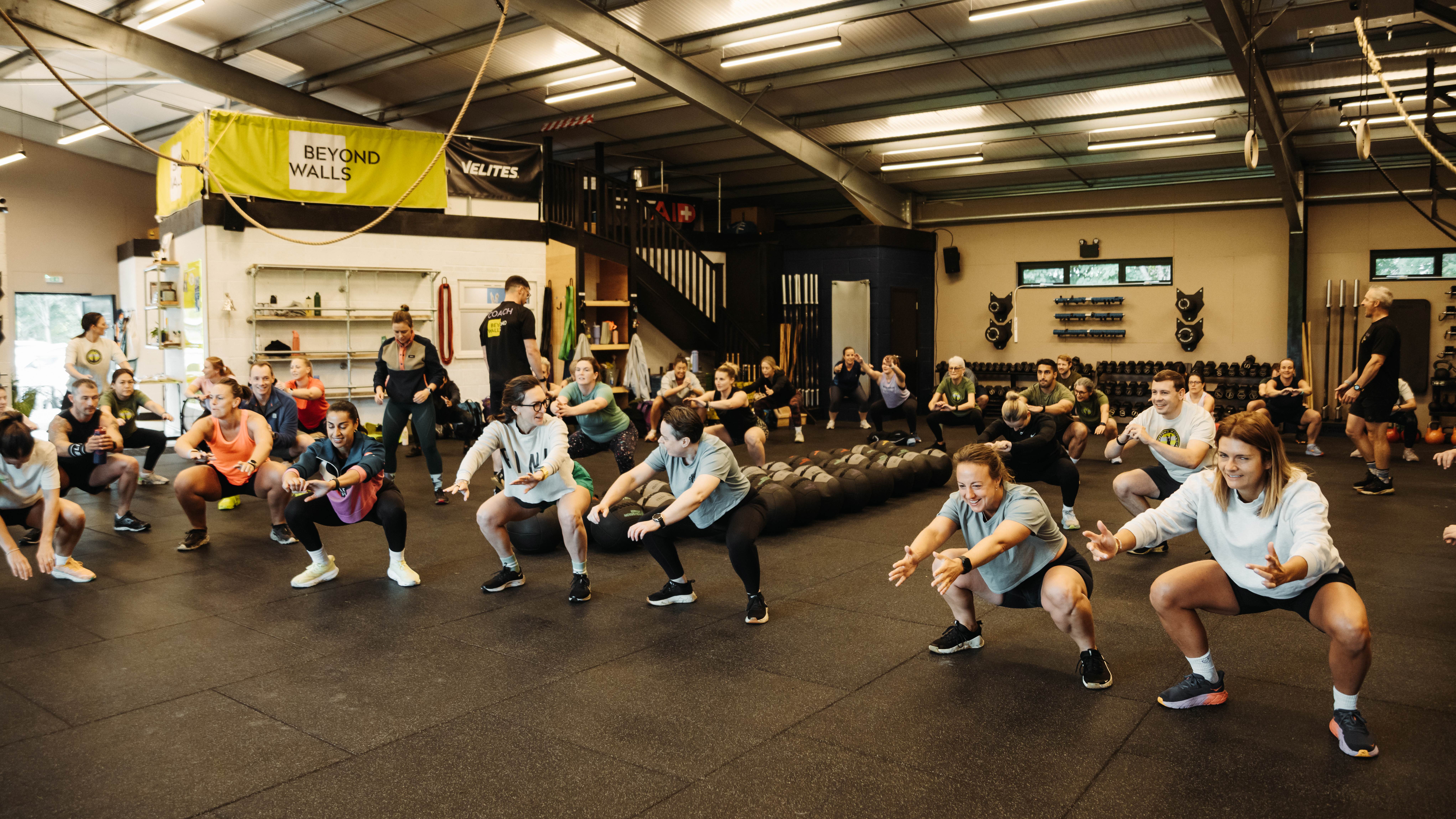
On a Sunday morning not long ago, 39 people turned up for a mobility class and the car park overflowed.
Mobility.
Not a competition. Not a celebrity seminar. Not a giveaway. Thirty-nine people gave up part of their Sunday to stretch, move and spend time together.
It is a small detail, but it says a lot about what has happened here over the past two years. Beyond Walls has grown quickly. But the growth is not really the story. The story is why people keep coming back.
From 12 people in a field
Our first recorded class was on 15 July 2024. It was outdoors, at 7am, and 12 people came. The operation was simple: bootcamp-style training, a small coaching team and an idea of what the gym might one day become.
Two months later, on 15 September, we opened the doors for the first indoor class.
Twenty-one people walked in.
Two years on, the difference is striking. In our first 30 days, members recorded 509 class and Open Gym check-ins. In the most recent complete 30-day period, that number was 2,822. More than five times as much training now happens here every month.
Since those first outdoor sessions, Beyond Walls has clocked up 43,898 class and Open Gym check-ins. More than 900 different people have trained with us, and once you include appointments, events and everything else, 1,000 people have checked in to the facility in some form.
Put those training hours back to back and you would have more than five years of continuous exercise.
Which is impressive. And also sounds absolutely dreadful.
But volume only tells part of the story. The more interesting numbers are about behaviour.
The Monday morning problem, and the 6am one
Most gyms struggle to get people through the door on a Monday. We seem to have the opposite problem. Monday is our busiest training day, with 7,706 Monday check-ins since the gym began.
Then there is 6am.
For most people, 6am is a time of day best experienced by accident, perhaps on the way to an early flight. At Beyond Walls it has generated 6,753 check-ins. Two hundred and nine different people have been to a 6am session. Polly B. alone has done 310 of them, with Tom S. close behind on 301.
There is clearly a serious conversation to be had about these people.
But the numbers reveal something. The strongest fitness communities are built on habit. Not motivation, novelty or the occasional heroic workout, but repeated behaviours that slowly become normal. At Beyond Walls, some of those behaviours have become almost tribal. The 6am crew is one. Committed Club is another.
When consistency becomes culture
Committed Club started in January 2025 as a simple way of recognising members who trained consistently. Thirty-nine people qualified in the first month. By July 2026, 120 did.
Across the whole of 2025, members earned 769 Committed Club qualifications. In the first eight months of 2026 alone, they had already earned 885.
What began as a sticker on a board has become a visible part of how the gym works.

Nine members have made Committed Club every single month since it started: Jayne C., Katie B., Rachel R., Nick H., Beatriz P., Claire P., Michael S., Tim F. and Ben G.
Twenty months out of twenty.
There is, however, a more troubling pattern in the data. People called Alex appear to be unusually good at fitness. Across 2025 and 2026, the various Alex’s at Beyond Walls have racked up 68 Committed Club qualifications between them. Emma is mounting a challenge on 56. For now, though, changing your name to Alex remains one of the more reliable ways to improve your consistency.
Peer-reviewed research is pending.
The people who simply keep turning up
There are more conventional records too.
Kerstin H. became the first person to reach 100 Beyond Walls check-ins, in December 2024. Ozma A. was the first to 250, in June 2025, and a year later the first through 500. Paddy B. joined her in the 500 club in August 2026.
Today, 160 people have passed 100 check-ins, 54 have passed 250 and two have passed 500. Ozma leads the all-time table with 569.
Then there is Michael S., who checked into 40 classes/open gym in August 2026. August has 31 days. Michael appears to have treated this as a challenge rather than a constraint.
Rachel R., meanwhile, has checked into 10 different types of Beyond Walls training, more than anyone else. She treats the timetable less as a schedule and more as a tasting menu.
These are fun statistics, but they point at something real. Members here do not get boxed into one class format or one training identity. They move between CrossFit, HYROX, gymnastics, weightlifting, Open Gym, mobility and a growing set of programmes built for different stages of life.
A gym becoming an ecosystem
CrossFit is still the heart of Beyond Walls, with almost 28,000 check-ins. But the gym has grown well beyond that core. There have been more than 7,300 HYROX check-ins, more than 2,600 Open Gym visits, over 1,400 gymnastics check-ins and more than 1,100 weightlifting check-ins. Three hundred and thirty-eight people have trained in both CrossFit and HYROX.
Alongside those sit EverStrong, New Chapter, YoungStars and Mobility.
That mix is one of the things we are proudest of. At one point in the day, experienced CrossFit athletes are training hard. Later, older members are working through EverStrong. A new mum is rebuilding strength in New Chapter. Teenagers are learning how to move and train properly. Someone else is in Open Gym doing their own thing.
All of them are part of the same community, coached by the same team.
That team has grown with the gym. When we moved indoors, the coaching operation was essentially Barry, Jamie and a bit of Julie. Today there are ten coaches.
This is the part we care most about getting right. Growth has not meant squeezing more people into the same product. It has meant more coaching capacity, more programme variety and more ways for different people to belong. Every member still gets coached.
Whatever class you are in, someone is watching how you move, helping you scale sensibly and telling you when you are ready for more. That is a very different thing from adding members faster than a building can absorb them.
The numbers you cannot put on a dashboard
The strongest evidence of what Beyond Walls has become, though, is found in the things that are almost impossible to measure.
Every so often, one of our members has a baby. Eventually, Mum comes back to the gym carrying the newest addition to the community. And everything stops. People abandon their coffees. Conversations end mid-sentence. Training pauses. Coaches briefly lose control of the room. Everyone wants to meet the baby.
There is no PushPress category for that.
Nor is there one for the friendships formed between people who happened to be given adjoining rigs. There is no field for members who stay for coffee long after class has finished, no attendance code for people who start going to competitions together, no KPI for noticing that somebody has not been in for a while and sending them a message.
These things are hard to quantify, but they may be the most important outputs of the gym.
Adherence is one of the great challenges in health and fitness. Finding an effective exercise programme is relatively easy. Finding one that somebody will still be doing a year later is much harder. Community changes that equation. People might start because they want to lose weight, get stronger or get fitter. They stay because they have found somewhere they belong.
Christmas is quite a useful metric
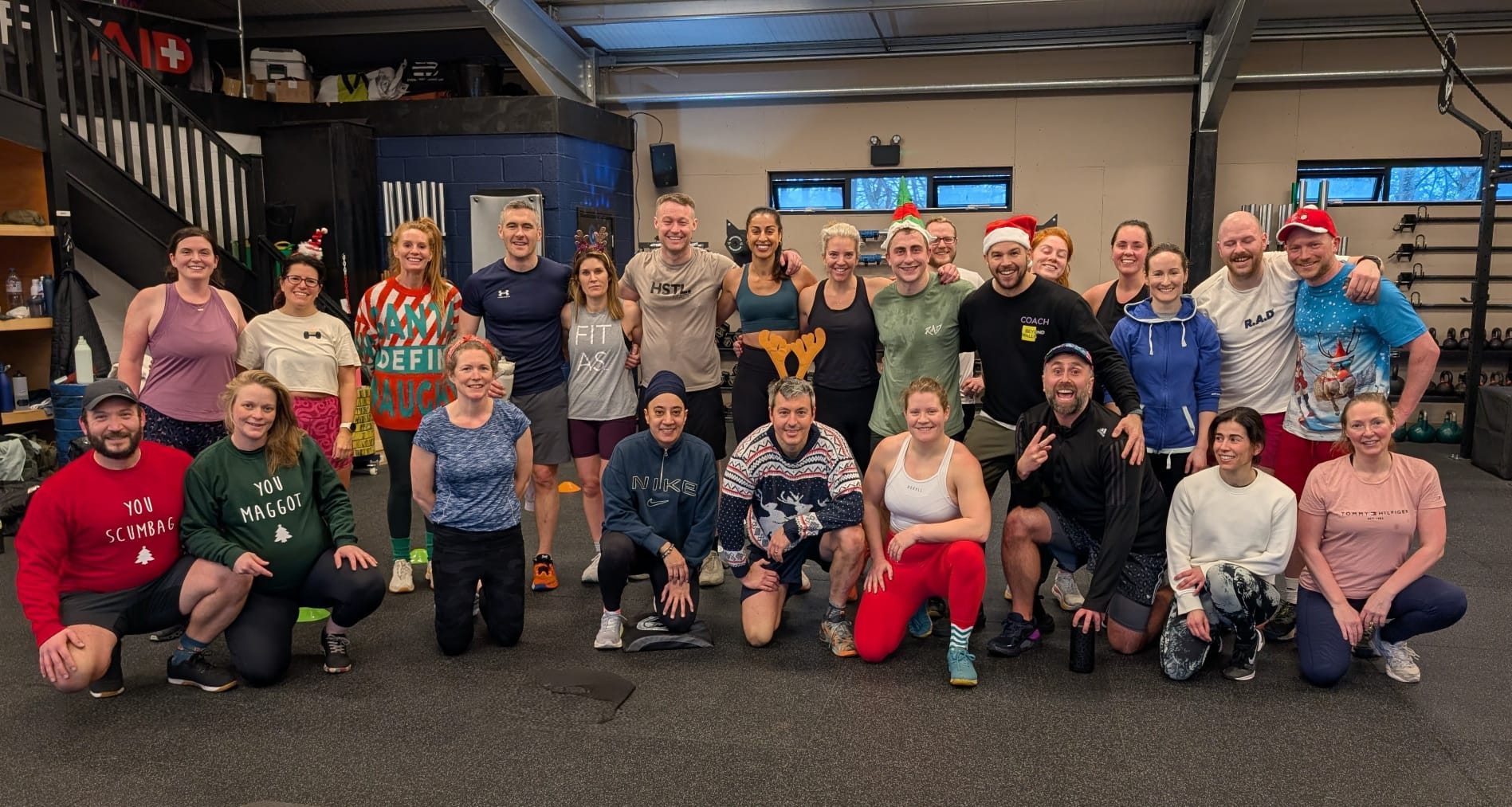
If you wanted one wonderfully unscientific measure of community growth, the Beyond Walls Christmas party would be hard to beat. The first drew around 35 people, and everyone fitted into one room of a pub. A year later, more than 100 came and the gym effectively took over the entire venue.
Christmas Eve training tells the same story. Thirty-one people trained on Christmas Eve 2024. A year later, 67 did.
There are two possible conclusions. The first is that the community had grown substantially. The second is that growing numbers of members wanted a legitimate excuse to escape Christmas preparations at home. For the purposes of this article, we will assume the former.
The annual member survey offers slightly more rigorous evidence. Asked how they first heard about Beyond Walls, more than half of respondents said a friend or family member had recommended it. That comfortably beat Instagram, Google and every other channel.
Commercially, that is impressive. In human terms, it matters more. Recommending a gym is personal. You are effectively telling someone you care about: I feel comfortable here. I trust these people. I think you will too.
Then there is the number that matters most
Growth is seductive. More members, more classes, more coaches, more check-ins. But none of those things prove a gym is improving anyone's health. They are inputs. The real question is whether anything changes as a result.
We have tried to measure that. Among 232 members with comparable InBody data, the collective result is striking.
Those members have lost 296.6kg of body fat. At the same time, they have gained 82.9kg of skeletal muscle. That is more than 47 stone of body fat gone across the group, while muscle mass went up.
For a gym whose stated aim is to measurably improve the health of its community, this is arguably the most important number in the whole dataset.
It is worth considering how those results came about. There is no dramatic intervention hiding behind them. No miracle challenge. No compulsory transformation programme. The mechanism is, frankly, rather boring.
People trained. They came back. They gradually increased what they could do. They built habits. They were coached. They kept going.
That is how meaningful health improvement usually happens. The fitness industry sells transformation as an event. Our data suggests it is a process.
What is actually being built here
It is tempting to look at all of this and see scale. But the more significant change is that Beyond Walls is becoming something closer to a small community institution built around health.
That sounds grandiose until you watch what happens here. Parents train alongside their children. Couples arrive together. Older adults have their own programme but share the same space and culture as competitive athletes. New mums return after childbirth.
Teenagers pick up habits that may stay with them for decades. People make friends. Babies are introduced. Someone inevitably has another coffee.
And in the middle of all of it, people get fitter.
That combination is harder to create than it looks. Facilities can be copied. Equipment can be bought. Timetables can be expanded. Programming can be downloaded. Culture cannot be manufactured.
Which is why the most interesting question facing Beyond Walls is no longer whether it can grow. It clearly can. The question is whether it can keep growing without losing the things that made growth possible in the first place.
What happens next?
Ask us where the gym will be in another two years and the answer is refreshingly unglamorous.
There is ambition, certainly. More people becoming healthier. Better programmes. Better coaching. Continued investment in the facility. More opportunities for members. Probably more Committed Club stickers than anyone has somewhere sensible to store.
But there is a line we will not cross. Growth will never come ahead of the three things we believe make Beyond Walls work:
world-class coaching, fantastic facilities and a genuinely strong community.
That may prove to be the most important decision of the next phase. The fitness industry has plenty of examples of businesses that got bigger. It has far fewer examples of gyms that got bigger while also getting better. Two years after 12 people gathered in a field for an early morning workout, we have a real chance to be one of them.
If the next two years look anything like the last two, somebody is going to need a significantly bigger spreadsheet.
And if you would like to be part of it, there is usually a coffee going. Come and say hello.